Behavioural insights: supporting Reef stewardship
Paddock to Reef social monitoring
Human dimensions indicators are monitored as part of the Paddock to Reef program to provide important insights into the factors that influence landholder and community involvement in water quality improvement projects. The social monitoring data presented in the Reef Water Quality Report Cards highlights the opinions of cane and banana growers and graziers engaged in practice change projects to reduce sediment, nutrients and pesticides being lost to local waterways.
Data is collected at the beginning and end of a project, prior to and after implementing a practice change. View the method for data collection.
An updated survey, the Paddock to Reef Perceptions of Practices (PoP) survey, has been in use since 2023. Data from this survey will be reported in future report cards. View the social monitoring factsheet .
Explore social monitoring results for 2023-2025
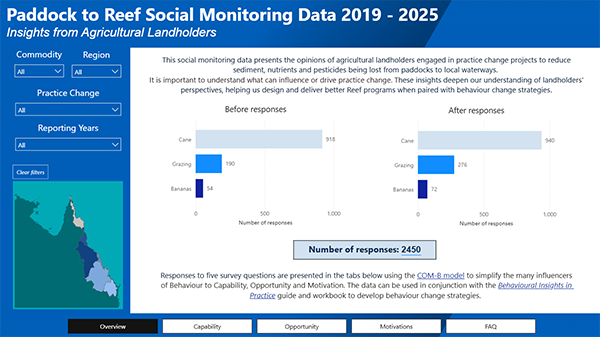
You can view the social monitoring data for the 2023-2025 period by clicking on the interactive dashboard below which includes data from 2019 to 2025. Data can be filtered by commodity, region and practice type.
The data explores whether landholders have the Capability, Opportunity and Motivation to engage in practice change on their property.
Why do we collect this data?
This information helps to provide an understanding of landholder perspectives and enables us to work more effectively by designing and delivering programs and communications that better suit landholders.
The behavioural insights from the data mean that project managers and extension staff have a better understanding of the attitudes, motivations and barriers for participants being involved in government funded projects and for practice uptake or change.
Additional data sets and resources
The Paddock to Reef social monitoring data tells part of the story of practice change happening in Reef catchments. Project snapshots provide landholder stories and examples of practice change journeys.
Landholders who have not participated in government funded projects are also making changes to their practices. Read more below:
The opinions of Reef catchment residents provide another perspective on the values of local waterways and the management of the Reef catchment:
Resources
Behavioural Insights in Practice – a guide and workbook developed by the Behavioural Insights Team at the Queensland Department of the Environment, Tourism, Science and Innovation
Social Practices and Diffusion of Environmental Stewardship (SPADES) full report and summary – research project (2025) into the social norms that shape agricultural practice and how they are communicated
Towards a human dimensions baseline – synthesis of social research data for farming practices (2018) which provided the foundation for the current Human Dimensions program
Recommended reading – a list of key research publications focusing on social factors influencing agricultural practice change
For more information or assistance in applying behavioural insights to your project, please contact the Behavioural Insights Team at OfficeoftheGBR@detsi.qld.gov.au.
- Last updated
- 26 June 2026