Regional report cards
Regional report card partnerships are one of a number of activities under the Reef 2050 Long-Term Sustainability Plan and are funded by both the Australian and Queensland governments. They bring together government and local communities including Traditional Owners, industry, farmers, scientists, tourism operators and conservation groups who have a shared vision for healthy waterways in their region. The partnerships produce report cards which provide scientific information in an easily understandable format for their communities, backed up by detailed scientific technical reports. The report cards outline the condition of waterways in their region. The data collected also guides management decisions around actions to improve water quality in local waterways that flow to the Reef.
To accommodate issues that are relevant to a specific region, regional report cards are based on subtly different indicators and data sources, but they all seek to:
- provide a finer scale, regionally-relevant assessment of the ‘health’ status of all waterways in a region
- assess the status of ecological, environmental, social, economic and cultural values of particular relevance to each region
- highlight environmental pressures that are best dealt with by local government and catchment management groups
- provide a linkage between what is happening in the catchments and how this affects the Reef
- unify the community on waterway health
- draw on data collected under the Paddock to Reef program and other monitoring programs.
Whilst the partnerships rely on data from outside sources to inform their report cards, they also collect their own data.. Marine monitoring data presented in the regional report cards includes Marine Monitoring Program data used for the Reef water quality report card, and is supplemented by locally-relevant data collected by port authorities, citizen science programs and the Australian Institute of Marine Science. In this respect, regional report cards are nested within the broader monitoring and reporting program for the Great Barrier Reef.
For more information about the different report cards, read the Report card explainer .
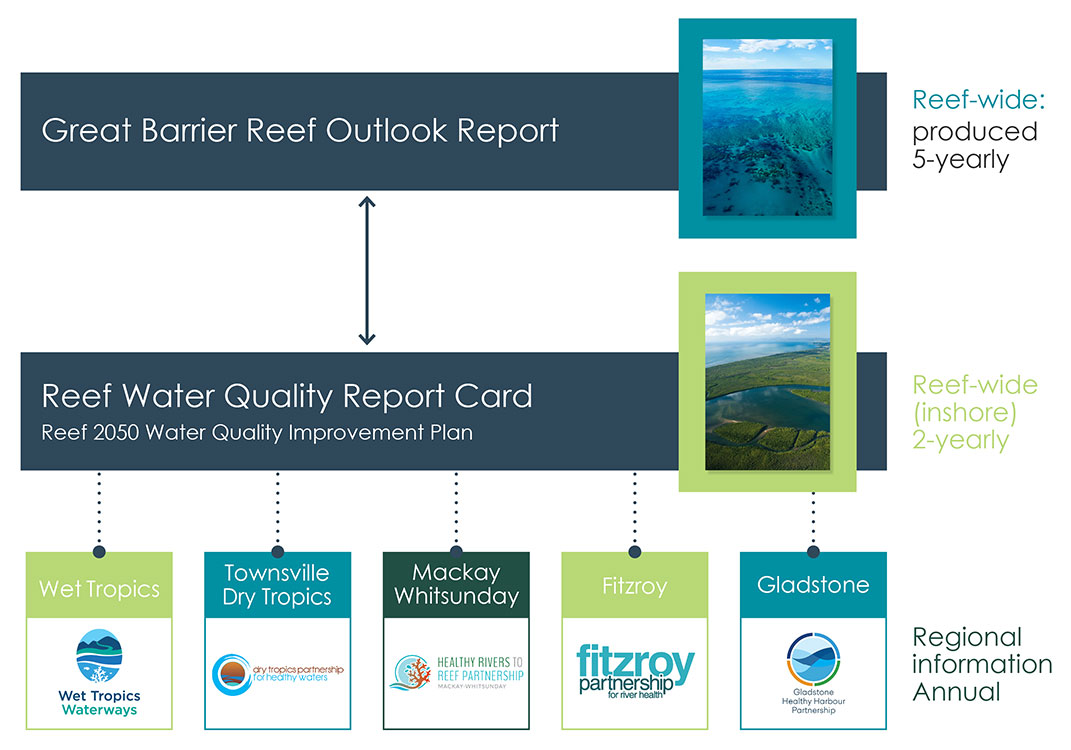
There are 5 Reef Regional Report Card Partnerships.
Wet Tropics Healthy Waterways Partnership
The Wet Tropics Healthy Waterways Partnership was formed in 2015. The report card covers the area from Bloomfield in the north to the Herbert River in the south and incorporates the Atherton Tablelands. It encompasses nine river catchments from the Daintree to the Herbert, eight estuaries and the adjacent marine environment extending to the eastern boundary of the Great Barrier Reef Marine Park.
Healthy Waters Partnership for the Dry Tropics
The Healthy Waters Partnership for the Dry Tropics was formed in 2018. The report card provides information about three catchments (Black, Ross and Bohle) in the Townsville region, along with the immediate estuarine and marine environments, the Port of Townsville and Magnetic Island. This partnership is unique as it focuses on the Townsville urban area, the largest urban centre in the Great Barrier Reef catchments.
Mackay-Whitsunday-Isaac Healthy Rivers to Reef Partnership
The Mackay-Whitsunday-Isaac Healthy Rivers to Reef Partnership was formed in 2014. The report card covers the geographic area of the Don, O’Connell, Proserpine, Pioneer and Plane basins; the urban area of Mackay; the ports of Abbot Point, Mackay and Hay Point; marinas; and the coastal marine area. Data in the Southern inshore marine zone is supplemented through a partner funded monitoring program, and inshore water quality monitoring in the Whitsundays is supplemented though a citizen science program.
Fitzroy Partnership for River Health
The Fitzroy Partnership for River Health was formed in 2012 and covers the Fitzroy basin. The report card covers 11 catchments (Nogoa, Comet, Upper Dawson, Lower Dawson, Theresa, Mackenzie, Upper Isaac, Lower Isaac, Callide, Fitzroy, Connors) and the Fitzroy estuary. It includes results for ecosystem health, agriculture and drinking water suitability in the Rockhampton Regional Council and Central Highland Regional Council areas.
This partnership has established the Fitzroy Regional Receiving Environment Monitoring Program, a basin-wide integrated monitoring program which replaces individual environmental monitoring requirements for participating industry partners (such as mining companies) that meets regulatory requirements. This program contributes to an integrated assessment of basin level aquatic ecosystem health to build a longer-term picture of water quality while identifying if there are any adverse impacts on waterway health as a result of coal mine water releases.
Gladstone Healthy Harbour Partnership
The Gladstone Healthy Harbour Partnership was formed in 2013. The report card is focused on the Gladstone Harbour and provides an independent report that assesses the environmental health of Gladstone Harbour and the social, cultural and economic health of the Gladstone local government area.
- Last updated
- 13 July 2026