Report card 2023–2025
About the report card
The three-year Reef Water Quality Report Card 2023–2025 provides the final update on progress against the 2025 targets under the Reef 2050 Water Quality Improvement Plan (Reef 2050 WQIP). The Reef 2050 WQIP has been superseded by the Reef 2050 Catchment Water Quality Strategy released in May 2026.
This report card is trialling a new approach that more clearly tracks progress against the targets. The new categories of ‘Target met’, ‘Improving’, ‘Declining’ and ‘No change’ better recognise the important contributions of landholders, industry and the community across the Great Barrier Reef catchments.
The report card draws on multiple lines of evidence including industry and extension programs. Science underpins the report card with all results reviewed by the Independent Science Panel.
Interactive report card
Explore the full results through the interactive report card.
Key results
- Catchment management highlights:
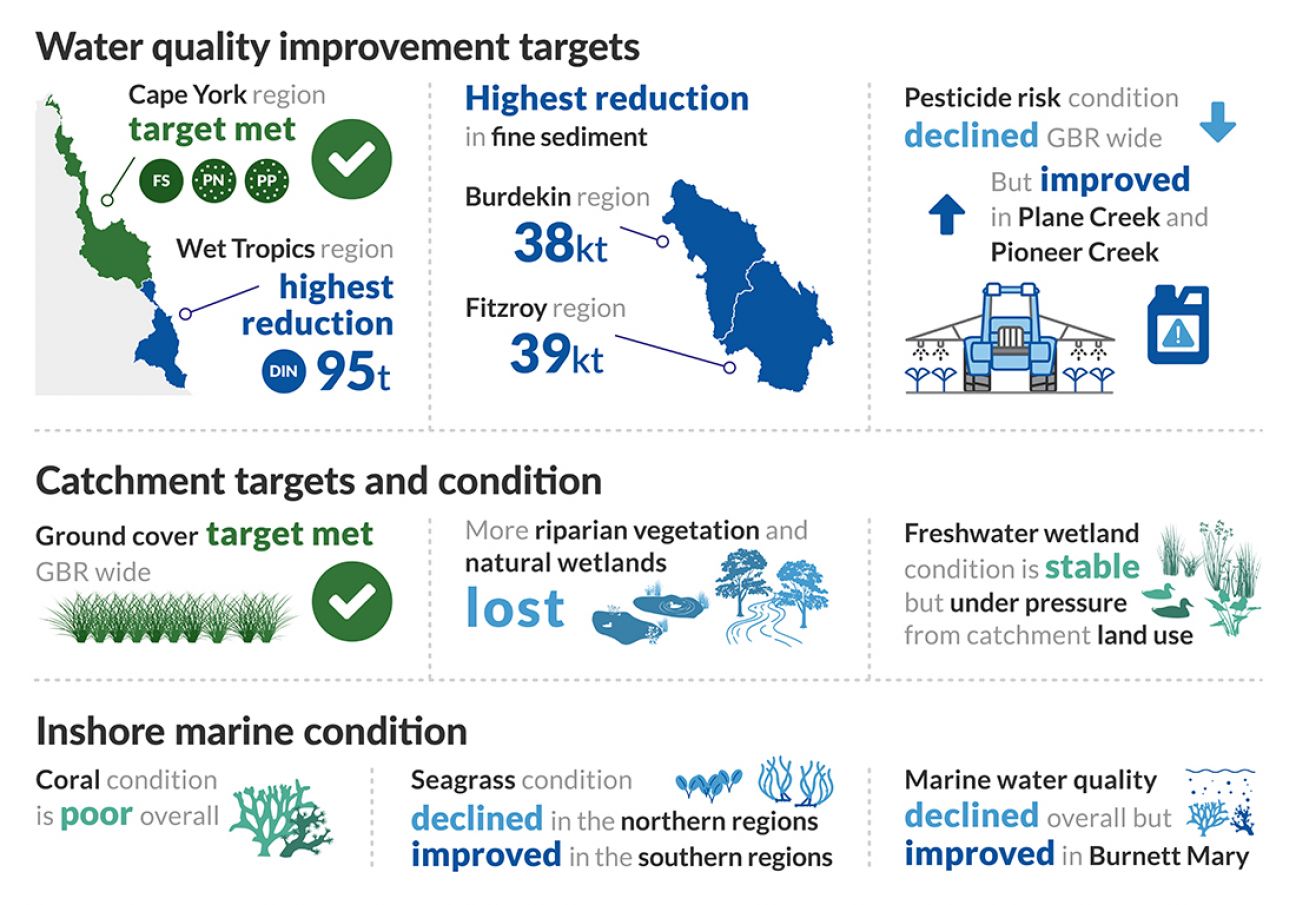
- Ground cover targets have been achieved across the Great Barrier Reef overall, due to favourable climatic conditions and effective land management practices.
- Loss of riparian woody vegetation extent was recorded across the Great Barrier Reef.
- Loss of natural wetlands has continued across the Great Barrier Reef.
- Catchment and inshore marine condition highlights:
- Freshwater wetland condition across the Great Barrier Reef overall has remained relatively stable, with moderate pressure from catchment land use.
- Inshore coral communities remain in poor condition overall, while inshore seagrass meadow condition declined to poor condition overall in 2025.
- Overall, marine water quality in the inshore Great Barrier Reef declined, likely influenced by above average rainfall and river flows during recent years.
- Catchment water quality highlights:
- Across the Great Barrier Reef overall, progress has been made towards each of the 2025 dissolved inorganic nitrogen, sediment, particulate nitrogen and particulate phosphorus targets.
- Cape York region achieved its 2025 sediment, particulate nitrogen and particulate phosphorus targets
- Regionally, the Wet Tropics recorded the highest reduction in dissolved inorganic nitrogen between 2023 and 2025, while Fitzroy and Burdekin recorded the highest reductions in fine sediment over the same period.
- Pesticide risk condition across the Great Barrier Reef is declining overall compared to the 2016 baseline, although levels of risk vary between regions and catchments.
- Management practice adoption highlights:
- Between 2023 and 2025, farm management improvements across 188,811 hectares of sugarcane cropping land and 2,653 hectares of banana cropping land contributed to reductions in dissolved inorganic nitrogen loads to the Reef.
- Farm management improvements across 1.71 million hectares of beef cattle grazing land, 12,518 hectares of sugarcane cropping land and 143,503 hectares of grain cropping land helped to reduce end of catchment fine sediment loads.
- Landscape repair projects remediated gullies at 57 locations, addressing erosion from 155 hectares of vulnerable land. Streambank remediation projects completed works at 155 rapidly eroding sites on major streams.
- Most agricultural producers participating in Reef water quality projects found that changing their land management was a good thing to do (100% of banana growers, 92% of sugarcane growers and 96% of graziers). Many also agreed that changing their land management was easy to do (85% of banana growers, 81% of sugarcane growers and 73% or graziers).
More information
For more information on how the key indicators were measured, please visit Methods.
To learn more about the opinions of landholders who have been involved in projects to improve water quality, please visit Behavioural insights: supporting Reef stewardship.
You may also like to view Project snapshots to learn about the people, partnerships and projects funded through the Queensland and Australian governments that are driving change, building resilient landscapes, productive industries, stronger communities and cleaner water for the Great Barrier Reef.
You can also view the Reef Water Quality Report Card 2023–2025 frequently asked questions .
- Last updated
- 13 August 2026